Evan Buechley
Seedlings, Schools, and Fish Eagles: A Year of TPF Complete Conservation™ in Madagascar
Saving a species takes far more than counting birds. In Madagascar, it takes trees, firebreaks, classrooms, land titles, and the trust of the people who live beside the wildlife.
Over the past year, the TPF Madagascar team put all of those pieces to work across four protected areas: Bemanevika, Mahimborondro, Tsimembo-Manambolomaty, and Mandrozo. The results show what TPF Complete Conservation™, our blueprint for species recovery, looks like on the ground.
Evidence That Drives Action
A main pillar of TPF Complete Conservation™ is the Evidence to Action Pipeline: we make conservation decisions based on the best available evidence through scientific research, monitoring, and adaptive management. Our monitoring work in Madagascar is extensive, reaching far beyond raptors to other species inextricably intertwined due to their mutual dependence on the landscape.
In Tsimembo-Manambolomaty, an August 2026 survey counted 65 Critically Endangered Madagascar Fish-eagles in and around the protected area, eight of them nestlings. Other surveys detected three diurnal lemur species and 34 waterbird species including the Endangered Malagasy Pond Heron (pictured below at top left) and Madagascar Heron (top right).
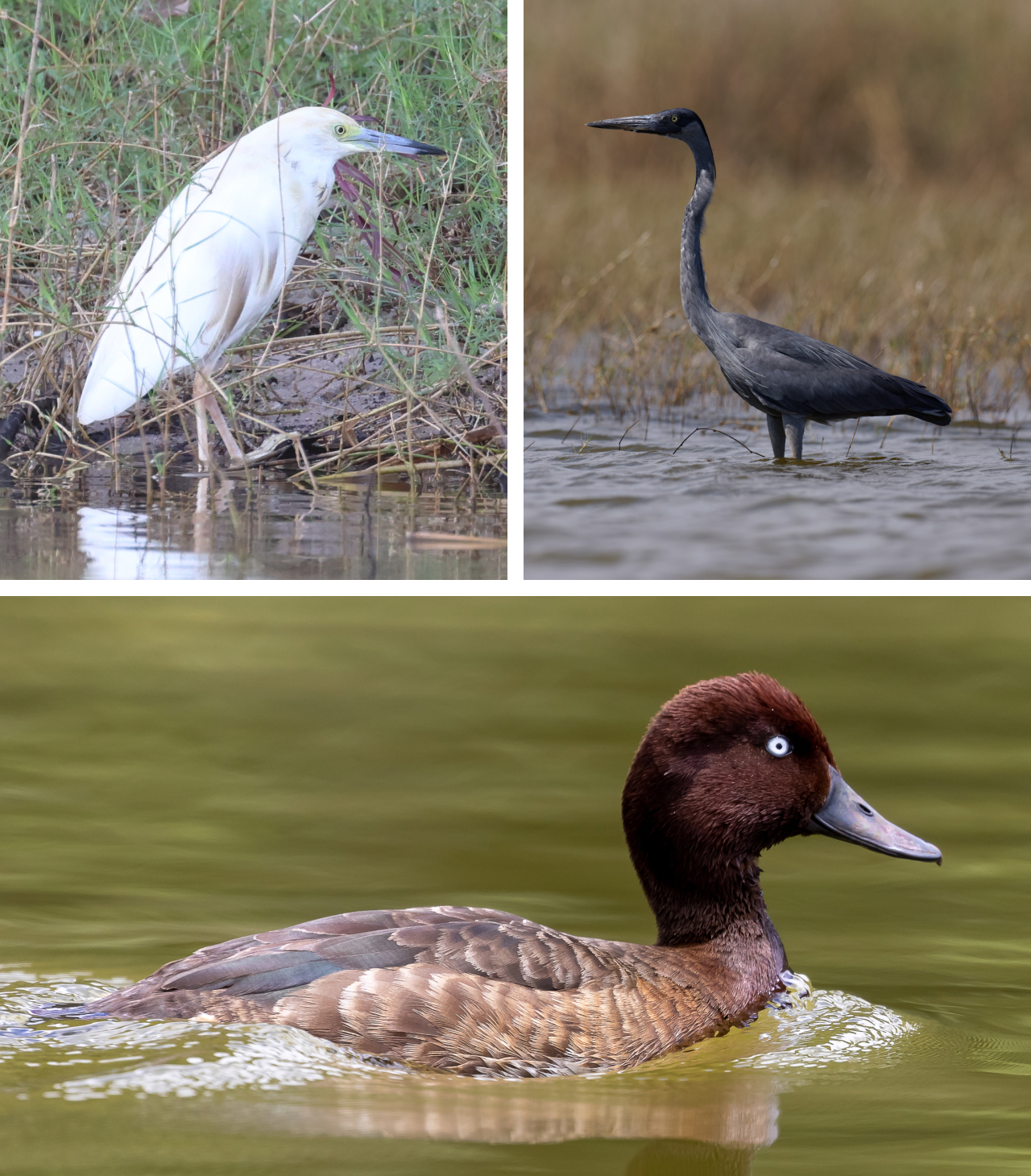
Over in the Bemanevika Protected Area, a census of chameleons in seven localities detected nearly 800 individuals, while a July 2026 waterbird census tallied 22 species and over 10,000 individuals, including five threatened species such as the Critically Endangered Madagascar Pochard (pictured above in bottom photo). While these numbers were generally encouraging, one concerning trend was noticed: of 12 previously known Madagascar Red Owl roost sites monitored in 2026, only two were occupied, both by a single individual. This data will drive our conservation efforts for this Vulnerable owl, and for all of Madagascar's wildlife, in the years to come.
Restoring Habitat and Defending It from Fire
Habitat loss due to deforestation and degradation has had profound impacts on all of the species that call them home, and restoring native habitat is therefore key to restoring Madagascar’s raptors. This past year, the TPF team alongside local communities planted nearly a quarter of a million seedlings, with later survival checks finding a 60–70% survival rate for the planted seedlings. To protect that investment, crews installed about 35 kilometers of new firebreaks, maintained nearly 60 kilometers more, and carried out 325 local resource patrol sessions. We helped form new firefighting committees in Mandrozo and Bemanevika, and purchased equipment for other community-based forest monitoring and fire management projects.
These efforts have multiple pillars of TPF Complete Conservation™ at their heart: the Species to Ecosystem Continuum, Collaboration, and Community-based Conservation. But this last pillar is on display elsewhere in Madagascar as well.
Putting People at the Center
Conservation lasts when it works for the people who live alongside it. We provided seeds, beehives, and site visits to farmers across the region. Fishermen surrounding Bemanevika and Mahimborondro Protected Areas received 10,000 young nursery fish, and we repaired around 50 fiberglass canoes for fishermen at Tsimembo-Manambolomaty and Mandrozo protected areas. We supported the 25 Village Savings and Loan Association (VSLA) of the Bemenavika and Mahimborondro Farmers’ Associations, supporting nearly 600 farmers, 68% of them women.
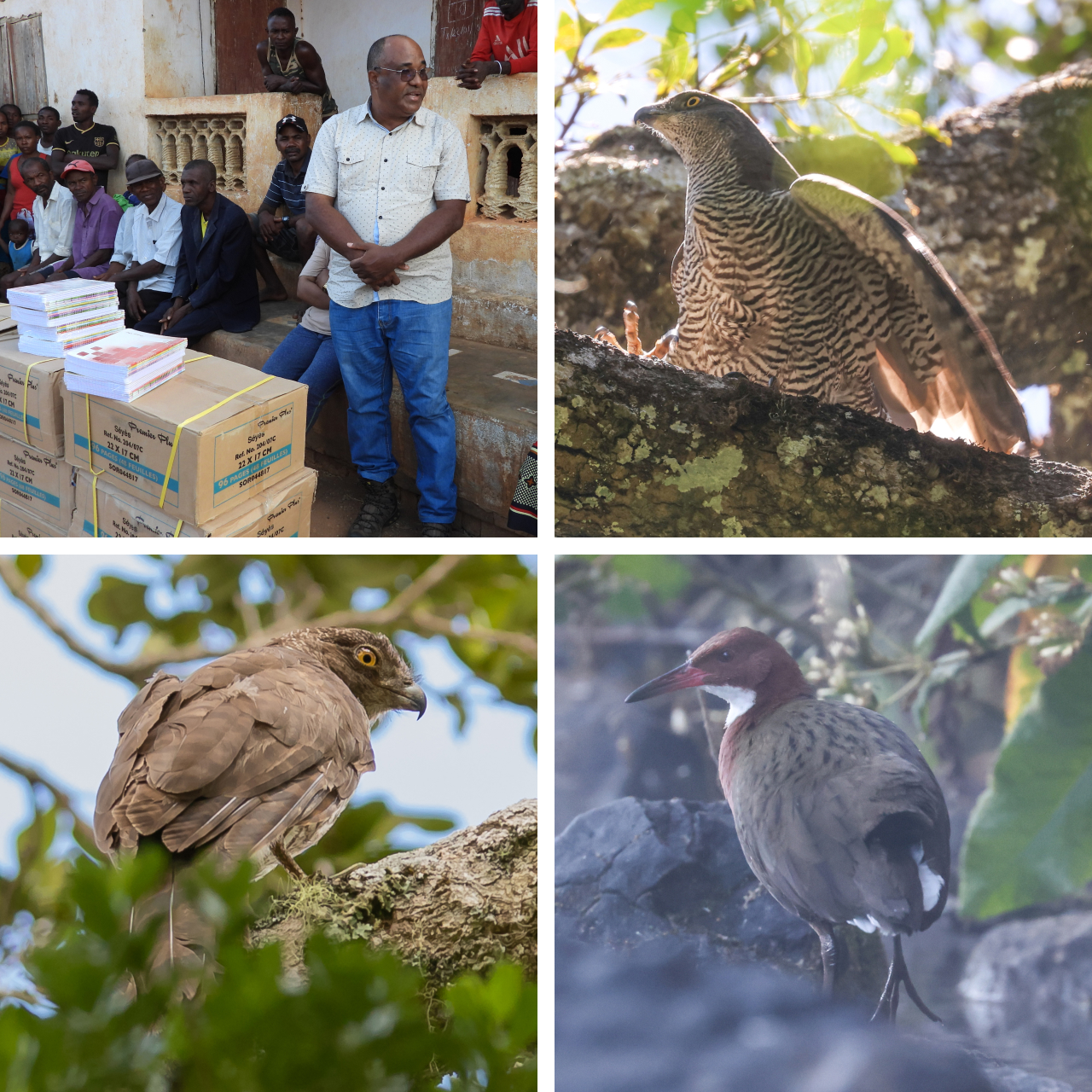
Five schools were renovated, and more than 10,000 notebooks and many other school supplies were provided to students across the protected area communities. (One such donation is pictured at top left below.) This investment in education is evidence of yet another TPF Complete Conservation™ pillar: Conservation Leadership.
Growing the Next Generation
Producing tomorrow’s conservation leaders is critical to ensure the momentum we make today carries on in future generations. Madagascar’s next conservation leaders are already in the field. PhD and master’s students supported by our program completed studies on the Madagascar Serpent-eagle (pictured in bottom left photo below) and Henst’s Goshawk (top right). In November 2025, two master’s students successfully defended their respective theses on rails (a family of typically shy and slender wading birds; a White-throated Rail is pictured bottom right) and on Madagascar Heron. Two undergraduate students defended their theses on a more sociological topic: the role of traditional taboos in the management of resources in protected areas.
The pipelines that produced these successes are ongoing, and perhaps a day to come, the fifth graders who received notebooks this year will be conducting their own graduate work, taught by this year’s graduates.
A Well-Earned Honor
All of these successes are earning recognition at the national level. On October 6, 2026, the Malagasy Academy approved the admission of Dr. Lily-Arison Rene de Roland, TPF Madagascar Program Director, as a Correspondent in its Applied Section. Founded in 1902, the Académie Malgache is a public institution devoted to researching and preserving Malagasy culture, history, languages, and sciences. In its letter, the Academy credited his research with helping to better understand Madagascar and the Malagasy nation. “It is a great honor for him, and a well-deserved one,” says Russell Thorstrom, our International Conservation Director and Lily’s longtime colleague and friend.
Hope in Action
Every result above reflects a pillar of TPF Complete Conservation™: evidence guiding action, communities benefiting alongside wildlife, investment in the next generation of conservationists, and care for whole ecosystems rather than single species. Help us keep this momentum going. Donate today to support Madagascar’s people and wildlife.