Franco Ogada
Against All Odds: How a Team Saved an Endangered Secretarybird Nestling in Kenya
It started as a routine trip to tag two Secretarybird nestlings. It became far, far more.
Back in early June, biologists from TPF Northeast Africa followed a Secretarybird after it bathed at a dam at Mpala Research Centre in central Kenya. They soon discovered its mate on a nest that likely contained eggs.
The find mattered. Secretarybirds are listed as Endangered by the IUCN and have the highest EDGE score of any raptor in the world, a metric that ranks conservation priority. The team logged the location and planned to return to tag the nestlings as part of our ongoing research on this understudied species.
A Nestling Struggling Alone
The team reached the nest early on September 1 and quickly saw signs of trouble. “Worryingly, we did not encounter any adults,” recalls TPF Northeast Africa Program Director Darcy Ogada.
It got worse. After the team set up a collapsible ladder and climbed to the nest, one of the expected nestlings was gone, and the one remaining was extremely thin. There was no food in the nest, and the team had no idea whether either parent was still alive. The biologists fitted the lone nestling with a GPS tag, but given its predicament, survival looked like a long shot.
So the team hatched a plan.
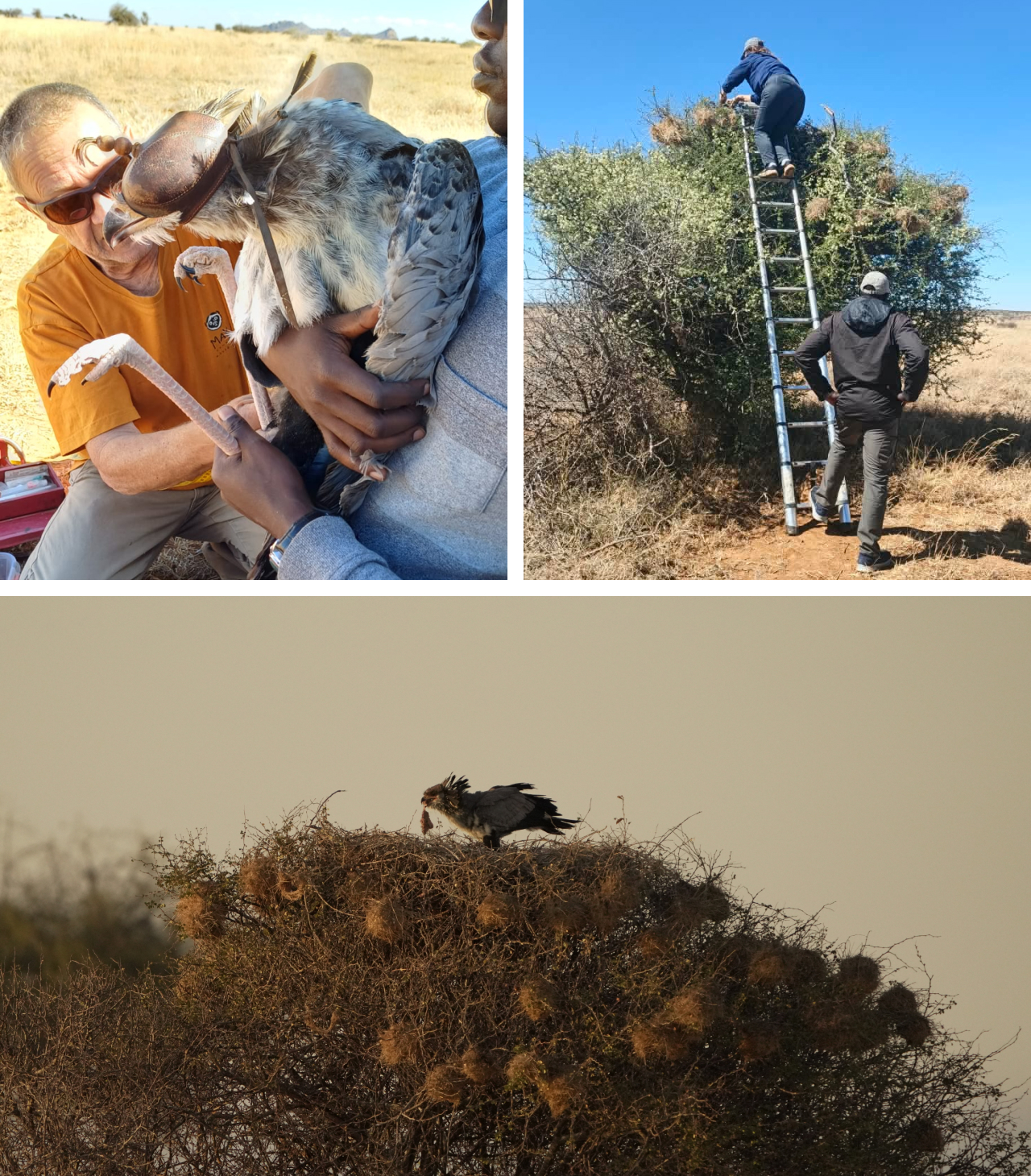
A Rescue That Took a Village
Saving this nestling would take all hands on deck, and it was clear it would need supplemental feedings. Mpala Research Centre provided an emergency food supply, which our team began delivering to the nest at regular intervals.
There was a catch. Disturbance at the nest could spook the already vocal, nervous youngster into jumping out before it was ready. To solve that, Kenyan expert Simon Thomsett of the Soysambu Raptor Centre designed a pole feeder that could deliver food without anyone climbing to the nest, and Mpala’s workshop hastily built it.
To watch over the nestling around the clock, the team borrowed a camera trap from the Mpala Baboon Research Project. And when our team had to head back to headquarters, a four-hour trip away, staff from the Vulturine Guineafowl Project, also based at Mpala, stepped in to keep feeding and monitoring the bird daily.
Against All Odds
It worked. After 16 supplemental feedings, researchers watched the now-fledgling Secretarybird walk the ground near the nest by day and fly back up to roost safely at night. The fledgling is pictured in the bottom right photo below walking near the nest on October 14; its GPS tag can be seen near its shoulders.
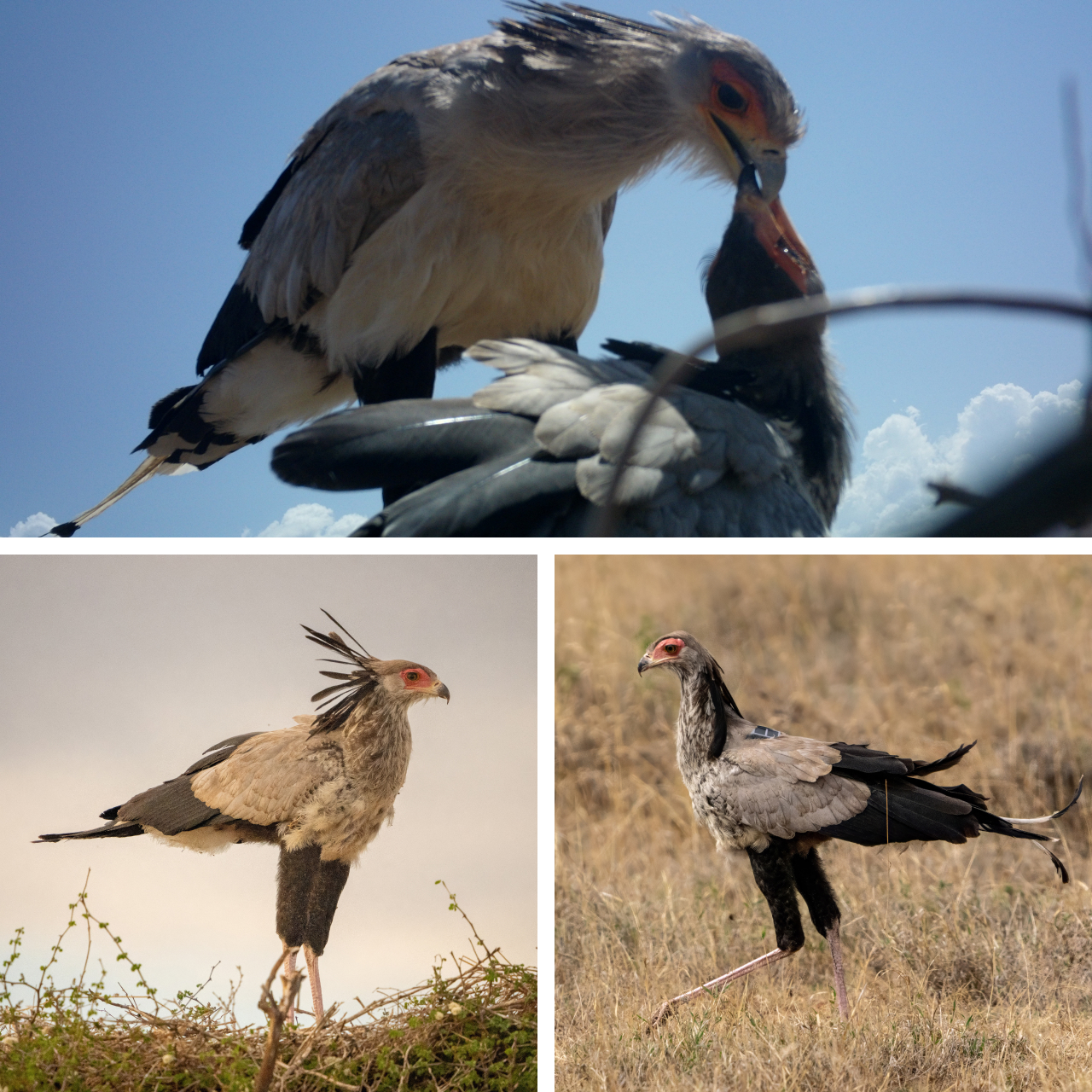
The added observations and camera trap images also helped to clarify what had gone wrong. “It turned out that both parents were still alive, but were only sporadically visiting the nest and feeding the nestling,” reported Darcy. “We don’t know if they were just poor and/or first-time parents, or the conditions were tough to find food.” One such visit, captured by the camera trap, is pictured in the top photo above.
Whatever the cause, this young raptor—a member of the highest-priority bird of prey species for conservation in the world—has survived to fledging age, a major milestone for any bird. The rainy season has also brought large insects for the young bird to catch, so supplemental feedings have decreased.
Our hopes are high that this Secretarybird will keep surviving and thriving, and will one day produce offspring of its own.
Our sincere gratitude goes to Mpala’s Vulturine Guineafowl Project for continuing to sporadically feed the young Secretarybird. Additional thanks to Simon Thomsett, Mpala’s Baboon Research Project, and Mpala Research Centre.