
Kelsey Tatton
From Data to Recovery: A New Study on Condor Eggs
California Condors have come a long way. In 1982, only 22 individuals remained. Today, that number stands around 600—a testament to decades of dedicated conservation work, including captive breeding programs like The Peregrine Fund’s.
But even with decades of progress, there is always room to do better. That's exactly what TPF Research Coordinator Carolina Granthon—who previously spent four years as a member of our propagation team—set out to explore.
Carolina, who is pursuing her PhD in Ecology, Evolution and Behavior at Boise State University, recently published the first chapter of her dissertation in the journal Ornithological Applications. The study was co-authored with TPF's Executive Vice President of Science & Conservation, Dr. Chris McClure, along with colleagues at Boise State University and the U.S. Geological Survey. It draws on nearly 30 years of breeding data—499 eggs from 26 female condors—collected at our Propagation Facility at the World Center for Birds of Prey.
The goal was to understand what influences egg size and fertility in captive condors and how that knowledge could make the breeding program even more effective.
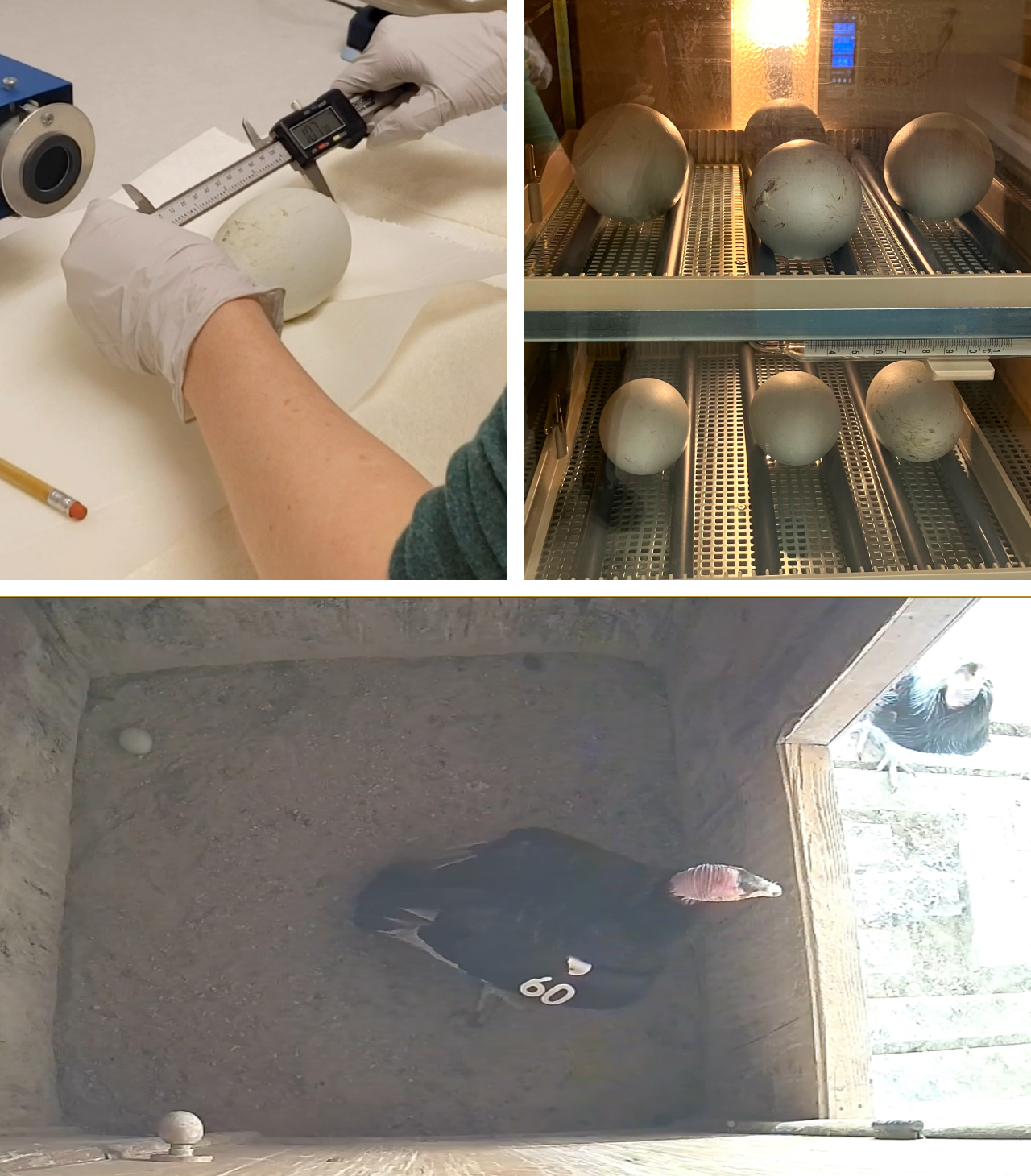
The findings were clear: when it comes to egg size and fertility, the female is the driving factor. Her age, above all else, proved to be the strongest predictor of both, with females performing best during their middle years (roughly ages 10 to 25). Younger and older females tended to produce smaller and more often infertile eggs. Notably, this is the first study to formally document reproductive senescence, or the natural decline in reproductive ability with age, in California Condors. The study also found that individual females varied significantly from one another in egg size, regardless of their environment or pairing, a finding that opens the door to more tailored, individual-level management of breeding birds.
This research is just the beginning. Future chapters of Carolina’s dissertation will follow condors through hatching, the fledgling stage, and ultimately their long-term success after release into the wild, building a fuller picture of what it takes to give each bird the best possible start. It's a perfect example of the Evidence to Action Pipeline, a pillar of TPF Complete Conservation™: rigorous science informing every decision, from the incubator to the open sky.