Ridgway's Hawk Conservation

in Neotropical Program: West Indies Program:

Status: Active, started in 2000

Donate

Goals:

Research and conservation of the Ridgway's Hawk

Background:

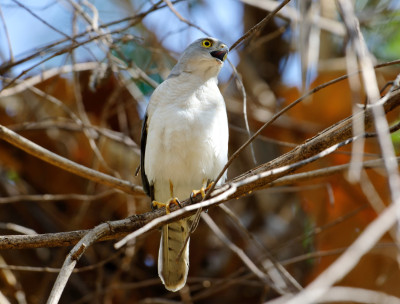
Critically endangered species and poorly known. One nesting biology study on three nesting attempts was conducted by Jim Wiley in 1976 and this is all that has been reported on this poorly known endangered species. Historically, Ridgway’s Hawks ranged throughout Hispaniola, countries of Dominican Republic and Haiti, but appears to have been extirpated from Haiti. The contemporary population is confined only to Los Haitises National Park in eastern Dominican Republic and not protected.

Recent Results:

2010 results

Four young hawks became independent from the Loma la Herraduara (Central Romano) release site during September 2008. By December 2008 two hawks with transmitters were no longer in radio contact either due to their transmitters stopped working, they had dispersed beyond the range of telemetry to be able to find them or they had been killed. In March, Carlos González Crespo was hired to supervise and direct the nest monitoring and aging of nestling Ridgway’s Hawks in the Los Limones community and handling and set up of the two experimental assisted dispersal releases. Unfortunately during June, Carlos González Crespo had to leave the project due to a developing health issue from a serious accident several years ago.

In April, the first assisted dispersal release took place at Punta Cana, a private company with a large land holding and resort in eastern Dominican Republic, located approximately 80 miles SE of the Los Limones breeding site in Los Haitises National Park. Kate Poulton, a volunteer from England, operated this release site with assistance from Bernardo Diaz Martinez, a volunteer from Mexico, and with assistance and support from SOH executive director Jorge Brocca. In April, five young hawks were moved to this release site and all five radio-taggeed young were successfully released. One young hawk from the 2009 release was observed within 100 meters of the release site during July. Also, in July one young hawk died from unknown causes and another died probably as a result of predation by a feral cat. The three remaining hawks reached independence during August at 150-160 days of age. The release box was closed during the end of August.

In May, four hawks were moved to a new release site for the third season of releases in Loma la Herradura and one of the young succumbed in the box from unknown causes. The reason for this new release site in 2010 was to establish increased security for personnel conducting the release near the housing staff of Central Romana. Samuel Balbuena de la Rosa from Sociedad Ornitología de la Hispaniola (SOH) and an assistant operated this release this year. In May, three young hawks were radiotagged and were released successfully. During July, the young radiotagged hawks were ranging several kilometers from the release site and had become independent during the first week of August at 135-140 days of age. In July, one of the released birds from 2009 was observed within 100 meters of the release box. In August, all young were moving a few kilometers from the release site and had become independent. Both release boxes were closed at the end of August.

SOH conducted a public awareness campaign from July to September where they presented 27 talks to 723 individuals from Punta Cana and locals living near the Loma la Herradura release site and in the community of Pedro Sanchez.

Challenges:

Project Links:

Project History (no field notes)
Publications and Data Other Information
Photos and Videos

Location Note:

Los Haitises National Park, eastern Dominican Republic

Species involved

People involved in this project:

Russell Thorstrom Director, Madagascar and West Indies Projects
Rick Watson Ph.D. Vice President and Director of International Programs
Thomas Hayes Ridgway's Hawk Project Coordinator
Marta Curti Biologist
Nojini
Jesús Almonte
Jorge Luis Brocca
Juan Cespedes
Samuel Balbuena de la Rosa
Eladio Fernández
Ben Hulefeld
Jake Kheel
Pedro Rodríquez
Lance Woolaver

Volunteer Opportunities:

Hack site attendant and Field Study Volunteer

Volunteer Positions Available – 2012 Ridgway’s Hawk Project Field Season

Volunteers are needed to assist with both field studies and releases of the critically endangered Ridgway’s Hawk in the Dominican Republic, as part of The Peregrine Fund’s and Sociedad Ornitologica de la Hispaniola’s (SOH) conservation program for this species. Volunteers may apply and be accepted for one or both positions.

Field Study Volunteer, March – June, 2012. Volunteers will work in teams of two to conduct nest searches and to monitor already known nests for productivity, hatch dates, nestling survival and fledging, and hunting success, among other things, and take detailed notes on their observations. This position requires long hours in the field, and strenuous hikes through uneven terrain. Extreme heat, heavy rain, and biting insects are common.

Hack Site Attendant Volunteer, April – September, 2012. Releases will begin in April, and may go through August or September, depending upon activation of the sites.  Starting dates are dependent upon when the young hatch in the wild. Volunteer Hack Site Attendants will be responsible for feeding and monitoring, through visual observations and tracking with telemetry, from six to fourteen young hawks from the time they are placed at the site until they reach independence.  A typed report (format supplied) will be required upon completion of the project. This position requires long hours in the field. Extreme heat, heavy rain, and biting insects are common. Most of your time will be spent observing the birds from a blind.

The success of the study and release effort will depend on the effort of the individual as well as the team.  Applicants receiving positions will participate in a unique study and assisted dispersal effort for the endangered Ridgway’s Hawk and gain valuable skills in nest finding, behavioral observations, telemetry, and field note taking.

Field housing will be provided for both positions and successful applicants will be sharing a room with at least one other person and a house with several crew members. Depending upon at which site successful candidates are placed, electricity may be spotty and there may be no running water. The project will supply each site with a spotting scope and tripod which must be returned at the completion of the study. 

Each person receiving a position will be responsible for their own round trip transportation from their home country to Santo Domingo, Dominican Republic. A per diem will be supplied to cover food costs.  Volunteer positions will be issued only to those over 18 years old. 

Some ornithological or other wildlife experience, as well as experience working outdoors in hot climates is desirable.  All positions will require long, challenging hours.  The short time in which the study can be completed, and the remote locations, precludes "time off" unless arrangements are made in advance. 

Please send a cover letter, resume, and the names and contact information for three references to:
Thomas Hayes, Ridgway’s Hawk Project Coordinator.
by e-mail: thayes@peregrinefund.org

Applications sent after 20 February 2012 should be addressed to Russell Thorstrom, West Indies Project Director: rthorstrom@peregrinefund.org

Cooperating Partners:

  • Cap Cana
  • Central Romana Cooperation, Ltd.
  • Fundacíon Mosco Puello, Inc.
  • Grupo PuntaCana, S.A.
  • Punta Cana
  • Secretaría de Estado de Medío Ambiente y Recurso Naturales
  • Sociedad Ornitología de la Hispaniola (SOH)
  • U.S. Fish and Wildlife Service
  • Wolf Creek Charitable Foundation