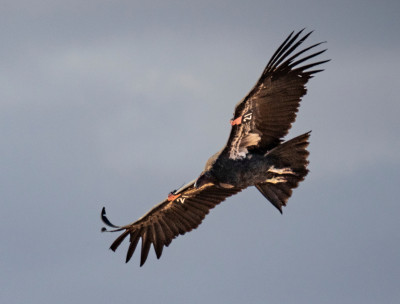
Establish self-sustaining wild populations of California Condors through captive propagation, release, and management with the ultimate goal of removing the species from the Endangered Species List.
California Condors are highly endangered — only 22 individuals remained alive in 1982. The Peregrine Fund started raising condors in captivity at the World Center for Birds of Prey in Boise, Idaho, in 1993 and three years later began releasing them to the wild at the Vermilion Cliffs release site in northern Arizona.
Through captive breeding, release, radio-tracking, and adaptive management, we are seeing real progress toward recovery. On Oct. 1, 2010, the total number of California Condors totaled 381. Of those, 76 were flying free in Arizona and 9 were in the pre-release pen at Vermilion Cliffs. The wild population in Arizona has produced 12 young since 2003.
Research shows that lead poisoning from spent lead ammunition is the principle mortality agent for the condor flock, which forages largely on its own, and we have made advancements in reducing the prevalence and impact of lead. State game and wildlife agencies in Arizona and Utah have initiated mitigating efforts to reduce the amount of lead available to scavengers. In 2008, The Peregrine Fund organized an international conference that focused on the effects of spent lead ammunition on wildlife and humans.
2010 Results
Fifty-seven condors reside at our captive breeding facility at the World Center for Birds of Prey in Boise, including 39 adults, 2 juveniles, and 16 chicks. Eighteen females produced 18 eggs and 17 were fertile. Of these, 11 hatched in Boise and six were transferred for rearing at other facilities. All eggs, including those transferred, hatched successfully. In exchange, five fertile eggs were transferred to Boise and all hatched successfully, bringing the total number of chicks reared in Boise to 16. We did not attempt to double-clutch any of our pairs. We had 94% fertility, 100% hatchability, and 100% chick survival. All the chicks at our facility were parent-reared.
Chicks were vaccinated against West Nile Virus according to the protocol established in 2009 and an aggressive mosquito abatement program was continued. In FY10, we began storing the vaccine in super-cold storage at the Biology Department on the campus of Boise State University to better maintain the integrity of the vaccine. Numerous changes were made to improve the facility and enhance condor behaviors.
We transferred nine captive-bred condors to the flight pen at the Vermilion Cliffs release site where they are monitored and evaluated before being deemed fit for release. We released six condors, one of which had to be recaptured 23 days later for poor roosting behavior.
Contaminant-free dairy calf carcasses were provided every three days at the release site. We intensely monitored newly-released condors and aggressively hazed them away from unsafe roosts in an attempt to avoid predators. Despite our efforts, one newly released female succumbed to coyotes.
Although condors have gone missing in the past, we always hope they will one day return. This year, however, we added four condors with intermittent or non-functional transmitters and two wild-hatched young to the “missing and presumed dead” category. From December 2009 to January 2010, condors 414, 426, and 454 were all last reported at roost in Utah and have since been unaccounted for, suggesting a common source of mortality. The timing is consistent with the period typical of lead-related death. The flock’s ever-increasing independence and use of habitats in Utah, combined with the large amount of inaccessible private property, increased our difficulty in tracking and monitoring condor behavior there.
Seven pairs exhibited breeding behavior during the reporting period, three of which were confirmed incubating within a nest cave. This year’s effort marked the earliest recorded laying date of 14 February. We obtained the first visual confirmation of this chick on 24 May. The possibility of a chick at a second nest is unconfirmed. All other nesting attempts were abandoned.
Our research has included observations of lead pellets and fragments in the digestive tracts of lead-poisoned condors and the discovery of bullet fragments in rifle-killed deer and coyotes fed on by condors. The Peregrine Fund continues to focus on lead exposure detection and treatment as the essential element in maintaining the population. Since the summer of 2000, we have trapped, obtained blood for lead-level analysis, and treated when necessary.
The period of highest exposure is October and November when the deer hunting seasons are underway, and the period of greatest lead-caused mortality among condors is December and January, reflecting the latency of effect.
We collected 75 blood samples (including re-samples), representing 61 of the 72 condors in the wild. Fifty-two of the birds showed lead levels indicative of lead exposure (>15 µg/dl), up from 43 birds in 2008. Twenty individuals revealed lead levels greater than 65 µg/dl, and 34 condors were treated with chelation therapy.
After 22 months without a confirmed fatality from lead poisoning, we detected three lead-related deaths in FY 2010. Necropsies and tests performed by the San Diego Zoo’s Institute for Conservation Research confirmed the presence of lead fragments in the digestive tracts of all three birds, two adults and a chick. The adults had been trapped and tested prior to the hunting season, and neither showed indications of high lead levels. All three birds had been foraging in southern Utah prior to their deaths.
With the aid of both GPS-satellite telemetry and ground tracking VHF telemetry, we again found an abrupt increase of blood lead-levels corresponding with increased use of deer-hunting areas on the Kaibab Plateau and the Kolob range in southern Utah in the weeks prior to testing. The worrisome disappearances in Utah of three other condors in December and January, the period of highest incidence of death from lead poisoning since condors began exploiting gun-killed ungulates in 2002, suggest the possibility that lead was implicated in those losses.
Our reduced staff of nine biologists and field workers tracked the daily movements and activities of condors throughout the reporting period, a task made more difficult by the increasing numbers of free-ranging birds and their widening tendencies toward long-range movement in this rugged region of limited access. We continue therefore, to benefit from satellite-reporting transmitters on 15 condors. These transmitters recorded hourly position fixes to within roughly 50 meters of the actual locations and transferred accumulated data each day to orbital satellite arrays. The technology was especially useful in the case of increasingly self-sufficient condors that failed to regularly return to the release site, as is now the case for many.
We continued to see what has become the normal trend of extended use of Utah, the northern end of the condor’s home range. From there in the hills just outside Zion National Park, the birds eventually returned to the release site as the winter snows made carrion more scarce. This period is characterized by an increasing use of the Kaibab and Paria Plateaus where condors have continued to encounter lead bullet fragments in the remains of shot deer, coyotes, and marmots. GPS transmitters have been especially valuable in revealing the exact locations of condor activity both in real time and in retrospect.
Close monitoring of movements also has aided us in quickly averting behavioral problems that still occasionally develop among inexperienced condors. We continue to condition them by hazing, installing aversive conditioning devices in highly used areas, and confinement. We continue our public education and outreach efforts in areas where condors and humans overlap.Southwestern United States, with a focus on the Grand Canyon area of Arizona